Giselle
Ballet de l’Opéra national du Rhin, Strasbourg, 2023
Nominated for the Benois de la Danse in 2024

Set design | Thomas Mika
Costume design | Catherine Voeffray
Light design | Tom Klefstad
Dramaturgy | Martin Chaix and Ulrike Wörner von Faßmann
Musical Dramaturgy | Martin Chaix
Music | Adolphe Adam, Louise Farrenc
Music Director | Sora Elisabeth Lee
Ballet for 25 dancers
Created on the 14th of January 2023 for the Ballet de l’Opéra national du Rhin
Original cast | Ana-Karina Enriquez-Gonzalez (Giselle), Avery Reiners (Albrecht), Dongting Xing (Bathilde), Susie Buisson (Myrtha), Alice Pernão (Hilarion), Di He (Moyna), Brett Fukuda (Zulma)

“If I can’t dance I don’t want to be in your revolution”
This Giselle keeps the relational architecture of Adolphe Adam's 1841 original intact. The deception holds. The betrayal holds. The question of forgiveness holds. These premises remain — and from that shared ground, their destinies become open questions.
Created for the Ballet de l'Opéra national du Rhin with dramaturge Ulrike Wörner von Faßmann, this production asks how the same relationships — a woman deceived, a man absolved, a community of women transformed by betrayal — might unfold when the characters are granted genuine agency over their outcomes. Not judging the original for belonging to its moment. Recognizing instead that performing these relationships in 2023 engages questions about power, consent, and representation whether consciously or not.
The feminist intervention extends into the score. Alongside Adam's familiar music, compositions by Louise Farrenc — a major nineteenth-century composer systematically erased from the canon — are woven into the musical fabric as structural presence, not decoration. A female compositional voice made integral to a ballet whose original musical world was built by and for the same institutional system that, as historian Marian Smith documents, treated its dancers as a secondary economy at the time. Farrenc isn't just added to the score. She becomes an inherent part of its essence.
The choreographic questions that guided this work — whether Giselle might find strength without seeking death, whether Albrecht earns the absolution the original grants him, whether Bathilde might refuse her conciliation — were not answered in advance. The answers emerged through movement, through what the bodies found when the libretto no longer decided for them.
Further…
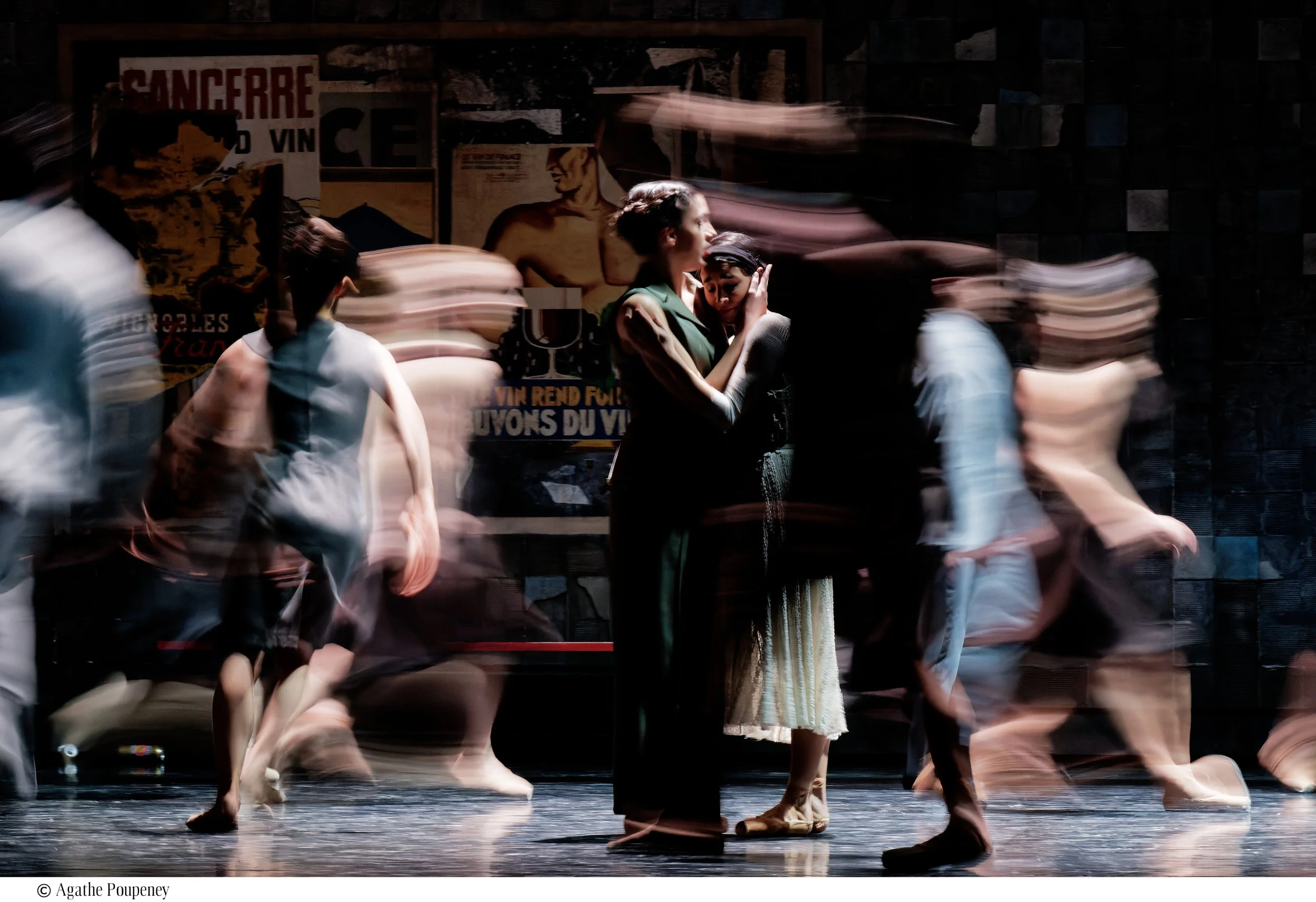
Photo © Agathe Poupeney
Photo © Agathe Poupeney

Photo © Agathe Poupeney

Photo © Agathe Poupeney

Photo © Agathe Poupeney
Photo © Agathe Poupeney

Photo © Agathe Poupeney

Photo © Agathe Poupeney

Photo © Agathe Poupeney
Explore more….
-
-
Mondprinzessin / Kaguya-Hime — Leipzig Ballet
QiXi / Magpie Bridge — Liaoning Ballet
Ma Mère l'Oye — Paris Opera Ballet School
A Streetcar Named Desire — Cottbus Ballet
-
Dora and Slava — Croatian National Ballet
Hammer — BallettCompagnie Oldenburg
Parlez-moi d'amour — Sibiu Theater Ballet / Leipzig Ballet / Mecklenburg State Theater Ballet
Atmosphères — Ballett am Rhein
Lachrymae — Landestheater Coburg
Tribulations — Ballet du Rhin
In a landscape — Busan International Dance Festival
Sinfonietta — Croatian National Ballet
Transkriptionen — Theater Nordhausen Ballet
This Giselle, created for the Opéra national du Rhin, begins with the same relational architecture as Adolphe Adam's 1841 ballet. A woman falls in love with someone who has deceived her. He is committed to another. The deception is revealed. Grief follows. The question of forgiveness arises…