Biography
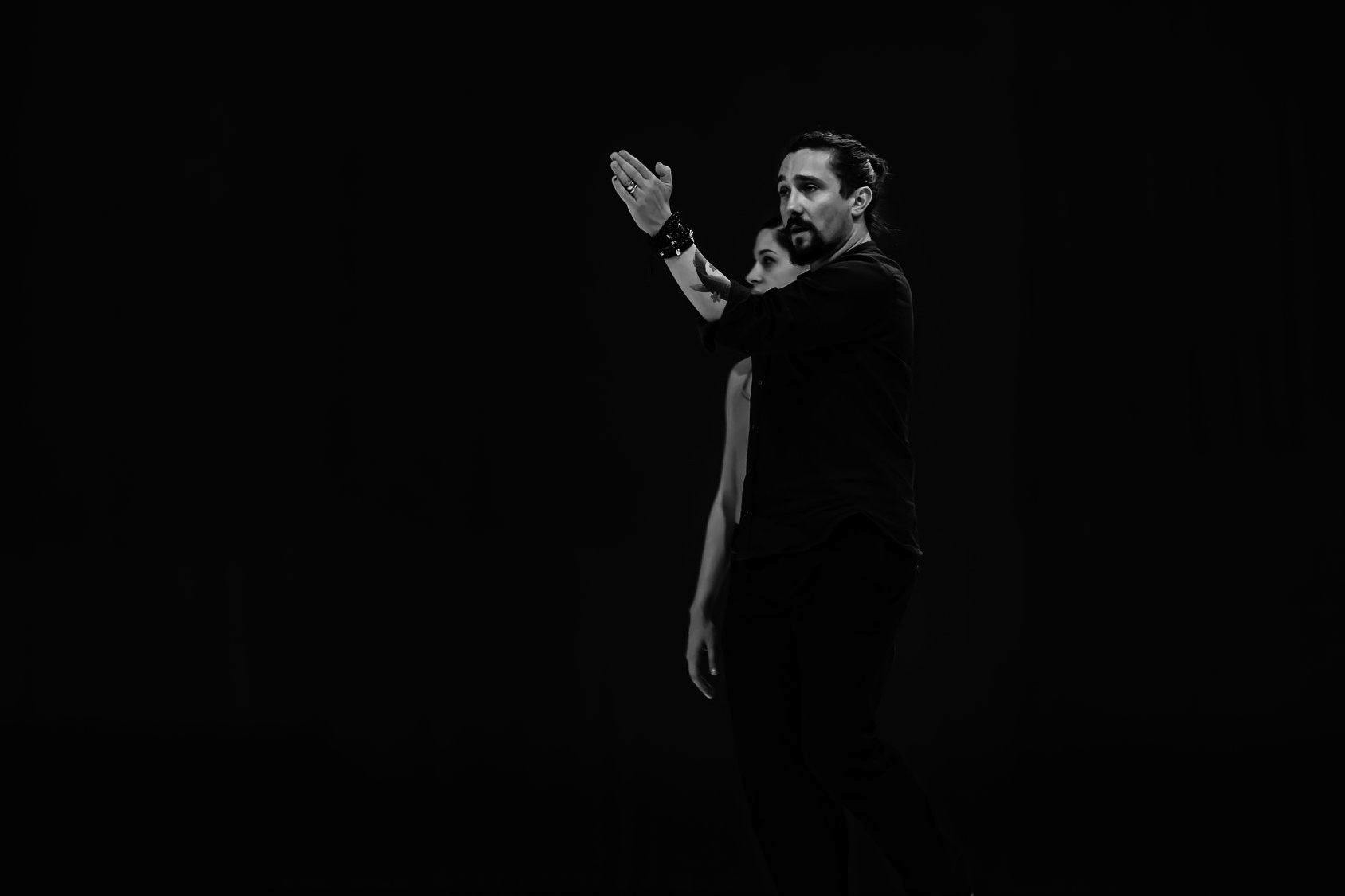
© Fanni Tutek-Hajnal
Martin Chaix is an internationally recognized choreographer whose distinctive voice has emerged at major ballet companies across Europe and Asia. Based in Germany, he has created over 30 works across 18 years, developing a choreographic practice that interrogates how classical ballet vocabulary can articulate contemporary consciousness through both cross-cultural artistic exchange and critical reexamination of the classical canon.
His 2023 Giselle represents a pivotal turning point in his career. This feminist reimagining of the Romantic ballet addresses contemporary political and societal questions, and in 2024 earned him a nomination for the prestigious Benois de la Danse. The production demonstrates his willingness to engage classical works not as preservation but as sites for urgent contemporary discourse. Critics have described his choreography as "melodies and chords of bodies, sometimes harmonious, sometimes dissonant" that function as "a seismograph of emotions," a quality particularly evident in this landmark work.
His 2024 creation QiXi for Liaoning Ballet in China represents a significant career milestone, demonstrating his ability to create work that bridges different cultural contexts while maintaining choreographic integrity. His international reach spans major ballet institutions across multiple continents. His work has included Silentium (2020) for the Bolshoi Ballet in Moscow, and for the Ballet de l'Opéra national du Rhin, Giselle (2023) and Tribulations (2018). He has created multiple works for Ballett am Rhein Düsseldorf Duisburg, including Atmosphères (2019) and "We were right here !!" (2013), and for Leipzig Ballet, where Die Mondprinzessin (based on the Japanese tale Kaguya-Hime) and other works developed over multiple seasons. His commissions extend to the Wiener Staatsballett in Vienna (M to M), Staatstheater Cottbus Ballet (A Streetcar Named Desire), the Croatian National Theatre Ballet in both Split and Rijeka, the Saarländisches Staatstheater Ballet in Saarbrücken, and theaters in Schwerin, Oldenburg, and Coburg across Germany.
Working with young dancers represents an important dimension of his practice. He has created significant works for the École de l'Opéra national de Paris (Ma mère l'oye, 2023) and the KK Youth Project in Tokyo (Sarabande, 2018), alongside projects with Austinmer Dance Theatre in Australia and Gymnasium Essen-Werden in Germany. This pedagogical engagement reflects his investment in nurturing emerging talent through the creation of new work. His collaboration with Les Arts Florissants marks a rare expansion into lyrical repertoire, demonstrating his versatility while his primary artistic identity remains rooted in choreographic exploration of classical ballet vocabulary.
Throughout his career, Chaix has developed sustained collaborations with leading designers and dramaturges, including set designers Thomas Mika and Felix Aarts, costume designers Catherine Voeffray and Aleksandar Noshpal, lighting designers Tanja Rühl and Tom Klefstad, and dramaturge Ulrike Wörner von Faßmann. These partnerships reflect his commitment to creating complete theatrical experiences where all elements serve the choreographic vision. Within this collaborative framework, he occasionally takes on design roles himself, creating integrated visual environments that emerge from deep engagement with the choreographic material. His artistic practice extends beyond the studio into photography and video work, with pieces selected for festivals including the One Minute Film Festival in Amsterdam. This multidisciplinary engagement informs his approach to ballet as total theater, where movement, space, light, and image function as unified artistic statements.
His choreographic approach emerges from an embodied understanding of classical technique combined with engagement with contemporary questions. Rather than preserving classical vocabulary, he actively questions and evolves it, creating work that speaks to current audiences while maintaining technical rigor.
Born in Albi, France, Chaix began his dance training there before entering the École de Danse de l'Opéra National de Paris (1993-1999). His fifteen-year performing career took him through three major companies - the Ballet de l'Opéra de Paris (1999-2006), where he advanced from corps de ballet to coryphée, Leipzig Ballet as a soloist (2006-2009), and Ballett am Rhein Düsseldorf Duisburg (2009-2015), again as a soloist, working extensively under Martin Schläpfer's direction.
During these years, he inhabited works by masters spanning the full spectrum of twentieth-century choreography - from George Balanchine's crystalline neoclassicism to Pina Bausch's revolutionary Tanztheater, from Merce Cunningham's radical investigations to Jiří Kylián's lyrical modernism, from Édouard Lock's explosive physicality to John Neumeier's dramatic narratives. Among the most formative experiences were works by Bausch, Lock, Uwe Scholz, Mats Ek, Marco Goecke, and Martin Schläpfer, alongside works by Carolyn Carlson, John Cranko, Roland Petit, Rudolf Nureyev, and Hans van Manen, among others. This extraordinary breadth gave him intimate knowledge of diverse choreographic languages and deep understanding of how bodies articulate meaning - a foundation that continues to inspire and influence his creative work, allowing him to deconstruct and reimagine classical vocabulary with both authenticity and precision because he knows it from the inside, in his body.
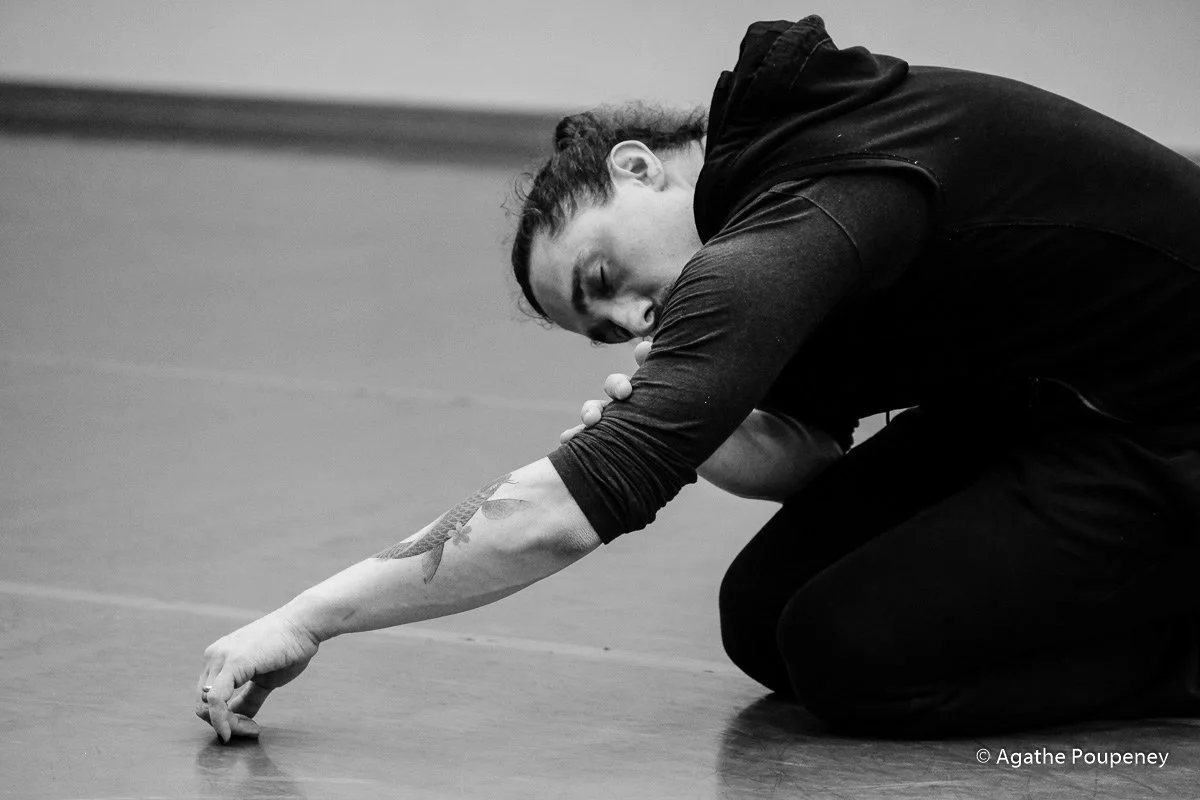
© Agathe Poupeney
Choreography has been a vocation since his early years as a professional dancer. While still performing with the Paris Opera Ballet, he made his choreographic debut in 2006 with Apologie du Couple le Matin au Réveil, and throughout his performing career he participated in "Young Choreographers" evenings, including an invitation to the renowned Noverre Young Choreographers evening in Stuttgart (2010). In 2015, he became a full-time independent choreographer.
Chaix works at the intersection of classical and modern dance vocabularies, creating a hybrid choreographic language that pushes beyond traditional boundaries while maintaining technical rigor and theatrical potency. His feminist Giselle and cross-cultural QiXi exemplify this approach - productions that fuse the precision of classical technique with contemporary movement to articulate urgent contemporary discourse, demonstrating that ballet remains a vital and evolving medium for addressing the questions of our time.
Biography current as of January 2025